
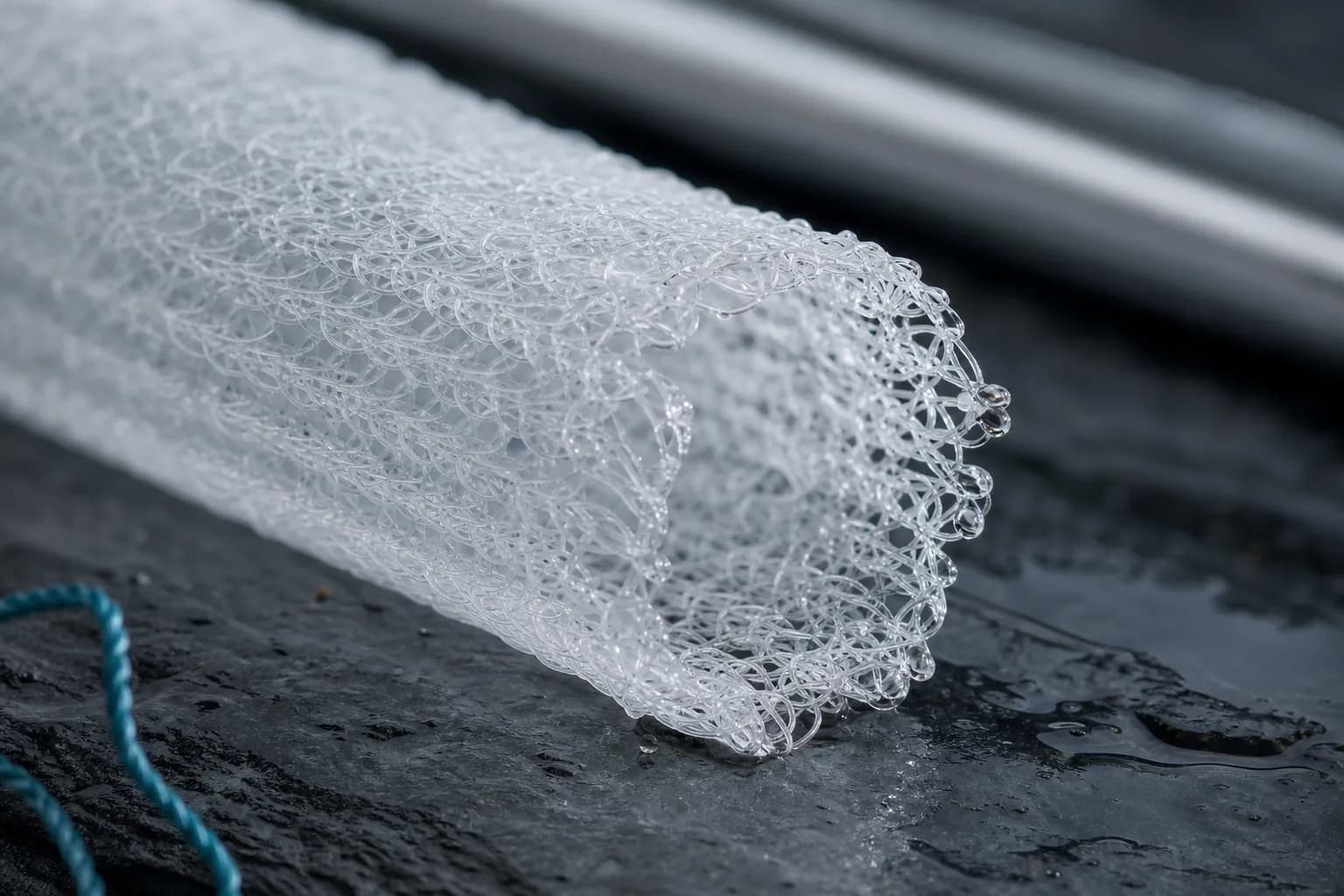
Laddering is the failure everyone recognises and nobody specifies against. One snagged strand and the whole sleeve opens up in your hands.
01 — What laddering actually is
A mesh is a knitted structure, and like any knit it can run. Break one loop under load and the failure propagates along the course rather than staying local. In the shop it looks like a quality problem; on the bank, in wind, with cold hands, it looks like the product falling apart.
Nobody tests mesh properly in a warm room. You find out what it does in November, at range, in a crosswind.
02 — What the weave changes
An anti-ladder knit stops a broken loop from propagating.
Finer mesh loads cleaner but is less forgiving of a snag.
More surface area per gram means faster, cleaner breakdown.
03 — Testing it honestly
We load it, cast it, and deliberately snag it — wet hands, cold weather, awkward angles. If a sleeve ladders under conditions an angler will actually meet, it goes back to the line rather than onto a shelf.
That feedback loop is short because the mesh is knitted in-house, on the group's own PVA knitting equipment. A weave change is a conversation with the people running the machine rather than a specification sent abroad.