
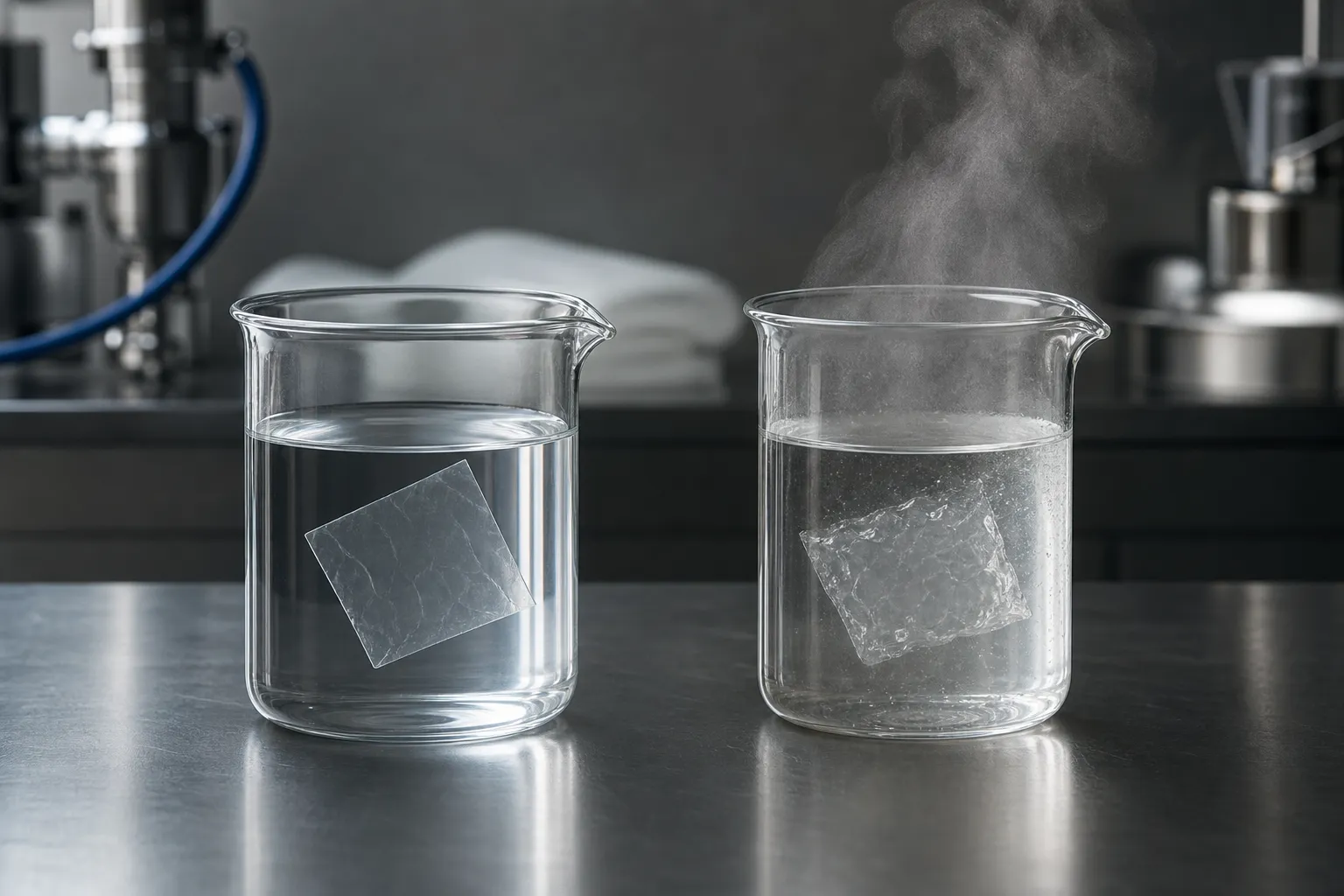
Cold water and hot water grades are not a quality ladder. They are two different tools, and the wrong one fails in a way that looks like a manufacturing fault.
01 — What actually separates them
The practical difference is the temperature at which the film starts to lose integrity. Cold water grades begin working almost immediately in ambient water; hot water grades hold their structure until they are given real heat. Both dissolve completely — the question is when you want that to start.
That threshold is not a single number either. It is a curve, and where you sit on it depends on gauge, agitation and how long the film has been absorbing moisture from the air before it ever got wet.
Pick the grade that survives your warehouse, then tune the dissolve. Doing it the other way round is how good film gets blamed for a storage problem.
02 — How each one fails
A cold water grade in a humid environment fails early: it softens, tacks, or loses seal strength on the shelf. A hot water grade in an application that never gets hot enough fails late — it simply does not go, leaving residue where the customer expected nothing.
Fast, ambient action. Vulnerable to humid storage and handling.
Stable on the shelf. Needs genuine heat to release properly.
Your storage, your water, your timing — not a controlled bench.
03 — How we would choose
Start from the harshest condition the film has to survive before it is meant to work, not from the moment you want it to dissolve. If the pack sits in an unheated warehouse through a wet winter, that constrains the grade before anything else does.
Then choose within the grade. Gauge and format both move dissolve behaviour, and the format is ours to change on our own conversion lines even though the film itself is sourced.